Don't Tell Me What to Do!
Amy Poehler shouted this at the camera at the end of guest appearance on SNL's Weekend Update segment 'Really?' which focused on the issue of birth control in America and American politics. This brief moment has stayed with me, echoing in the back of my mind.
It seems like the kind of thing a child would shout, being unable to form a nuanced, logical argument. But when Amy shouted it, to me it seemed completely radical. After countless articles, speeches, rallies, discussions, years . . . patriarchal society still doesn't get it. We've tried the nuanced, logical argument approach. What it boils down to is that these patriarchal, sexist, misogynist, racist, prejudiced systems and people have no right to tell us who/what/how to be and what to do.
Don't tell me what to do! It gets at the fundamental issue of power imbalance. You think that you are better than me, more capable than me, that I should obey you because you are a man. Well you aren't and I'm not going to.
The fact that Amy Poehler is wise and bold enough to shout this at the top of her lungs on national television is a beautiful gift.
via GIPHY
Try saying it some time yourself. Preferably to someone who is trying to silence you or control you. It's pretty great. I've done it.
At lunch at work, my coworkers had the tendency to fuss around me whenever I was cutting an apple or pear. My female boss would ask me if I wouldn't rather let one of the guys use the knife for me. Male coworkers would instruct me on how to hold the knife. Seriously? How do these people think I have survived this long unable to cut an apple? I still have all my fingers and limbs. One day I retorted, Amy's voice in the back of my mind, "Don't tell me what to do!" No one was giving the men in the office tips on wielding culinary instruments. If they didn't need to tell other people what to do, they didn't need to tell me.
When getting into a discussion that requires challenging sexist or racist points of view, whenever I made a strong point male coworkers, flustered that I had 'scored' as it were, would joking tell me to "just go and [insert something related to my job]." While meant as a good-natured way to acknowledge that I was right and that they were wrong, the fundamental joke about the statement was the unspoken truth that the world would be better if I would just go disappear, just go shut up---so that they didn't look bad, so that they didn't have to hear something that took them safe zone of male privilege. The goal of such a statement was in the end to silence me as a woman (and protect them from ever having to truly acknowledge that they were wrong or ignorant). It would all be fun and games until someone accidentally said "just shut up woman and make me a sandwich." I've now deployed Don't Tell Me What to Do 'jokingly' back at them.
It almost always shuts down the sexist behavior immediately. It so cleanly and precisely exposes the underlying assumptions that men should control women and that men know better that women and that women should obey men. It's like a sharp knife that cuts right to the bone. It avoids getting bogged down in debating the nuances of politics, nature vs nurture, whether or not you have statistics at your finger tips to back up your claims . . . it just points out: you think you're better than me, well, you're not. When I want your advice, I'll ask for it.
You're not the boss of me. Don't Tell Me What to Do.
Friday, March 25, 2016

Tuesday, March 15, 2016
Primary Day
Today is a big day for Ohio. It's the day that we as voters actually matter. It is primary election day. For some reason that I've never really understood, Ohio is a hugely important state in national elections. Maybe it just boils down to electoral votes and delegates, maybe it's something else, but either way, voting here is always important. In a state that never consistently goes red or blue, every vote matters, so I went to cast mine today.
I wanted to have a voice, to take the time to say "This is who I believe would lead and represent the country/county/area well, and they support the things I believe in." However, saying that is not always easy, especially in the part of Ohio I grew up in and currently reside in. I live just north of Cincinnati. Until the past two presidential election cycles, all of the counties in the area went red. About as bright red as they could get. When Obama first won in 2008, that was the first time in my life I had ever seen Hamilton County (the county that contains Cincinnati) go blue. Every other county was still bright red, however. I live in prime, gun-loving, pro-life, pro-god-in-schools, anti-gay, anti-anybody-who-isn't-a-
Given the area I live in, and given recent events that unfolded in the past few days as Trump made appearances very near me in West Chester, and not too far away in Dayton, I went to the polls a little apprehensively. When I went to vote, I was asked for my ID (problematic in itself. See this John Oliver video for more- LINK), asked to verify my name and address, then I was asked which ballot I wanted to receive: republican or democrat. I stood at the table, and before I muttered my answer, for the first time in my life I was actually afraid to cast my vote for a non-republican party. I became very aware of the two older white men glaring at me as they waited for their voting cards, after they heard me respond with "Democrat, please." I became very aware that Ohio is a state that allows concealed carry, and that many people in this area support and take advantage of that law. As I went to vote today, I was reminded of all of the things that were done by generations past to ensure that I could even go vote in the first place, and I was also reminded of all of things that are being done to people who don't agree with the hateful rhetoric being touted by a certain candidate. After voting I spoke of my unease with a relative of mine, who is rebellious in that she dares to be a female democrat in the heart of the south. She told me that I was not alone in my fear and anxiety, that she was also afraid to show support for either democratic candidate because she feared the repercussions. She was afraid her car would be vandalized, or worse, that she would be shot for simply displaying signs or putting a sticker on the bumper of her car.
The only time that I ever feel patriotic is when I go and vote. I'm not sure that the same can be said for me today. Instead of feeling pride in trying to make my voice heard, I felt something much different. I felt ashamed that this process has become such a circus, and a second-rate one at that. I'm ashamed that while my voice and my vote might go the opposite way, the image that this country is projecting internationally is one of hatred and intolerance. Today, I voted, and today, I felt ashamed that I was afraid to be heard.
Marketing: the enemy of women in film?
A few weeks ago I attended a female-centric film festival in New York. This was my second time at the film festival. I was really excited to go back because I had a really good time the first time around. I was hoping to learn more about the barriers that hold women back in the industry and learn the innovative ways women were coming up with to break those barriers down or at least circumnavigate them. I was particularly excited to attend a panel of female short film directors speaking about barriers, and a panel on unconscious bias. With all the talk about diversity and gender discrimination in the industry, I thought this festival would be full of vibrant solutions and ideas for the future.
Unfortunately, this really wasn't my experience. (I write about it more in this post for TYCI.) Most of the solutions proposed rather seemed to support the status quo, and panels were often fraught with disagreement as panelists argued over what the right solutions were, or even what the problems were. Most disappointingly, digital media was almost never mentioned, which had been something I had expected to hear a lot about. I suppose that this teaches me one thing: it's silly to treat 'women in film' as a monolith, full of women who all have the same experiences and share the same opinions and perspectives. There is power in having a diversity of approaches to making change; when one solution doesn't work, perhaps another might be more effective. One size does not fit all.
However in thinking back over what I saw and heard at the festival, and trying to figure out what helpful lessons I could glean--- even if they weren't the ones I was expecting to find--- one issue floats to the surface: marketing.
Several times throughout the festival, filmmakers mentioned clashing with marketing teams and described how marketing ended up becoming an oppressive and/or anti-feminist force under which they or their projects suffered.
When asked about why her film Jennifer's Body, while very amusing and written by a popular, Oscar-winning writer, had flopped so badly, director Karen Kusama described how much of the film's problem was the way it was marketed. (You can watch here.) While she had envisioned the film as a horror/girl comedy made mostly for women in which Amanda Seyfried played the main character, the marketing team's main approach revolved around "We've got Megan Fox. She's hot." The film ended up being marketed as a sexy horror film, directed towards young men, and starring Megan Fox. I found this really interesting, because I remember when Jennifer's Body was being marketed and distinctly remember deciding not to see it because it looked like a stupid sexy-Megan-Fox vehicle--- it didn't look like something was made for me, included me, or respected me.
Kusama says the film confused the marketing team by being both a comedy and horror, and being a story that mostly centered around girls and girls' experiences. The "default setting" Kusama says for marketing then becomes "just market it to boys." Kusama recalls being flummoxed by trailers that never showed the main character of the movie (Amanda Seyfried's character) because it focused on teasing whether or not Fox's body would be exposed. Kusama also mentions begging the marketing team not to ask Megan Fox do press with porn sites because it would have just been too demoralizing to the actress. "We're selling a lie," Kusama commented on the marketing strategy, and emphasized how impactful how the movie is framed in the press and to critics can be.
I found Kusama's story about Jennifer's Body really thought provoking, because it got into the details of an issue I had heard hinted at many times in other places. It pointed out a harsh reality that even once you've made your female-centric, female-lead film . . . if the marketing team is not on the same page as you and doesn't share your goals, they can still kill you film, bury your message, and make your project inaccessible. Often times we are so focused on just getting the film made, and making a good film, everything that comes after is a bit of an afterthought. However, the way the film gets marketed can be a big fight that can make or break whether your story gets heard and reaches those you are seeking to reach.
So perhaps this is one thing women can do to improve the representation of women in film/television on and off screen: get more marketing savvy, become feminist marketers, select marketing teams carefully, and stay in control of the marketing of your projects!
Monday, March 7, 2016
Dropout Reads: The Chalice and the Blade
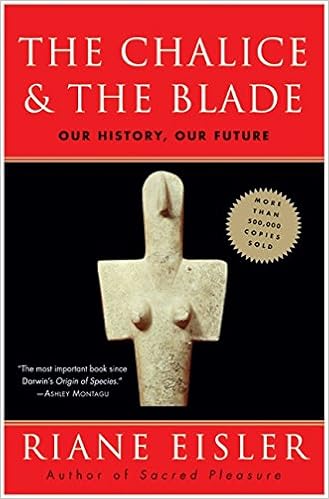
Its been a while since I've done a feminist book review, so when Riane Eisler's The Chalice and the Blade: Our History, Our Future became available through my public library's digital collection I decided to give it a try. Unbeknownst to me, this book is considered a seminal work in women's studies and remains a best seller under Amazon.com's "Women's Studies History" category.

I must admit that I found the book to be a bit of a mess. I've found that "seminal works" often cover too much ground, lack focus, and end up repeating themselves haphazardly in their quest to revolutionize established systems of thought. All three criticisms apply in this case. Despite these shortcomings, however, I believe the book's underlying premise offers great value. Let me explain.
I must admit that I found the book to be a bit of a mess. I've found that "seminal works" often cover too much ground, lack focus, and end up repeating themselves haphazardly in their quest to revolutionize established systems of thought. All three criticisms apply in this case. Despite these shortcomings, however, I believe the book's underlying premise offers great value. Let me explain.
The Premise
Eisler's thesis revolves around two proposed societal models: partnership societies and dominator societies.- Partnership societies value creation and renewal. Their interpersonal relationships link people, connect them, and stress affiliation. Power and organization are used for enabling and actualizing functions.
- Dominator societies, in contrast, value violence and destruction. Their relationships are ranked such that some individuals hold superior positions over those deemed inferior. Its power structures pursue domination. This model arguably prevails in our current reality.
Tuesday, February 16, 2016
Spinning Tales, Women's Productivity, and Rumpelstiltskin
Several months ago, L asked me what I thought the story of Rumpelstiltskin was really about. If you're not familiar with the tale, this version by the Grimm Brothers (1810's) is the most well known. There is a boasting miller, his daughter, a king, rooms filled of straw, a strange magical little man, some questionable contracts, and an ambiguous moral. A quick Google search reveals just how baffling this strange little story is for most modern readers.
I too was baffled, but with some research skills and access to university library databases I found an amazing article:
To support this theory, the author cites an earlier version of the tale where a hapless maiden can only spin flax into gold (no boasting miller). In her world, gold thread is pretty but essentially useless. In short, she's absurdly inept at an essential task. A little man comes by and promises to help and in doing so, make her an appealing choice for a discerning gentleman. In return, he demands her first child. In other words, I have skills you desperately need/want, I'll teach you, but you'll have to pay me. She says yes and a prince marries her (no more spinning anything into gold). Once she has her first child, the little man comes back to test her by demanding his payment. She resists and he offers his name-guessing test. After two days of failure, she rallies her ladies community who go in search of the answer. They find it and the little man flies out on a ladle (a women's implement).
Moral of this earlier story: learn to spin so you'll be a valuable asset to your husband and your community; use your ladies network and control your fate.
While this isn't a fantastic moral by modern standards, it's far better than the Grimm version. In hindsight its easy to see why the version we know is so baffling: it does not reflect a stable, immutable oral tradition. Instead, it reflects a man's interpretation of a woman's tale amidst women's changing economic roles. As women lost their economic value, their role in stories also transformed: they became passive, helpless bystanders as men and magical spinning machines determined their destinies.
Makes so much more sense than most modern interpretations!
I too was baffled, but with some research skills and access to university library databases I found an amazing article:
Zipes, Jack. (1993). "Spinning with Fate: Rumpelstiltskin and the Decline of Female Productivity." Western Folklore. 52 (1) Perspectives on the Innocent Persecuted Heroine in Fairy Tales: 43-60The author begins his discussion by noting the long and rich tradition of spinning-related folktales across many cultures, with the spindle symbolizing female productivity and a cultural or community center. Mothers and grandmothers would tell these tales to their daughters and granddaughters as they spun, making essential products for sewing and weaving for their communities. As the industrial revolution took hold in Europe in the 18th and 19th centuries however, women's economic roles changed. Essential spinning and weaving tasks that once happened at home were outsourced to the new mechanized economy. Spinning tales once rooted in the community became un-moored. Zipes argues that the Grimm Brothers folk tale collection coincides with this transformation. As a result, their strange Rumpelstilkskin tale is a story caught between women's traditionally productive spinning roles and their more ambiguous roles in Europe's industrializing economy.
To support this theory, the author cites an earlier version of the tale where a hapless maiden can only spin flax into gold (no boasting miller). In her world, gold thread is pretty but essentially useless. In short, she's absurdly inept at an essential task. A little man comes by and promises to help and in doing so, make her an appealing choice for a discerning gentleman. In return, he demands her first child. In other words, I have skills you desperately need/want, I'll teach you, but you'll have to pay me. She says yes and a prince marries her (no more spinning anything into gold). Once she has her first child, the little man comes back to test her by demanding his payment. She resists and he offers his name-guessing test. After two days of failure, she rallies her ladies community who go in search of the answer. They find it and the little man flies out on a ladle (a women's implement).
Moral of this earlier story: learn to spin so you'll be a valuable asset to your husband and your community; use your ladies network and control your fate.
While this isn't a fantastic moral by modern standards, it's far better than the Grimm version. In hindsight its easy to see why the version we know is so baffling: it does not reflect a stable, immutable oral tradition. Instead, it reflects a man's interpretation of a woman's tale amidst women's changing economic roles. As women lost their economic value, their role in stories also transformed: they became passive, helpless bystanders as men and magical spinning machines determined their destinies.
Makes so much more sense than most modern interpretations!
Sunday, February 7, 2016
Gender Roles & Children's Toys: An Intractable Challenge
We've discussed gender roles and children's toys here at this blog (see our Lammily and GoldieBlox posts for example), and it is heartening to hear that major retailers like Target are moving away from gender-based labeling/shelving for their toy offerings. When considering this gender-toy arena, my response has typically been, "Yes! More gender-neutral toys! How hard could it be!?"
Well . . .
Over the past few months I've been teaching myself how to sew. With a sewing machine from the 1960's and fabric from a few of my spouse's old work shirts, I've practiced the basics with a series of simple projects. For one project, an adorable stuffed robot, my result was less robot and more baby, but I loved it so much I made three.
One of my cousins has a two-year-old, so I decided to send at least one of the toys to her. Then my feminist blogger mind thought, "I should make sure this toy imparts no gender expectations to the little female recipient." This seeming laudable and straightforward task immediately presented two problems.
Problem 1: What do I call these things?
Trying to describe these toys in a gender-neutral way, I immediately ran into language hell. While "stuffed toy" is accurate and gender neutral, it is just too generic to be meaningful. I tried "doll," which is also accurate, but as I wrote in an earlier post, technologies (including dolls) are social constructions as much as they are physical objects. Girls get "dolls" and kitchen play sets, boys get "action figures" and Erector Sets. This dynamic goes back decades, if not centuries. If "doll" carries too much baggage, what to call them? After I told my spouse how the dolls' weighting reminded me of a baby sitting in a diaper, he started calling them "diaper babies." That's the best I've come up with so far.
Problem 2: How do I ensure this toy is gender-neutral but also engaging?
I originally planned to send the toys off as they are, but then feminist blogger brain got started again.
While I will go to my grave believing that the soft, squishy, cuddly nature of these toys makes them instantly engaging, I will also admit that toys offer children a medium to role play and explore their worlds. A doll without any features or clothes whatsoever offers unlimited possibilities, but it also fails to reflect reality. This seems like a major shortcoming.
My first solution was to give them clothes. My sewing skills aren't there yet, but hey, I'm willing to learn. However, on further reflection, the clothes solution just adds new problems. What kind of clothes would be neutral? Then I considered adding hair, but same problem. Are pig/pony tails gender-neutral? If I have two dolls in overalls, one with "boy" hair and one with "girl" hair, am I perpetuating a stereotype? What about neutral hair on two toys, one with a boy face and one with a girl face? Wait, that just plays into the bow, boobs, and eye-lashes trope (see Ms. Male Character).
Now as I write, I'm wondering whether the blue color (associated with boys) is a problem. The "make engaging gender-neutral toys" thing is taking a toll on my sanity. How do we help children learn about their world through play without also teaching them our society's preconceived notions about gender and gender roles? Needless to say, these unbelievably complex, innocent-looking little bastards are still sitting in my house taunting me.
Well . . .
Over the past few months I've been teaching myself how to sew. With a sewing machine from the 1960's and fabric from a few of my spouse's old work shirts, I've practiced the basics with a series of simple projects. For one project, an adorable stuffed robot, my result was less robot and more baby, but I loved it so much I made three.
 |
| My plush progeny |
Problem 1: What do I call these things?
Trying to describe these toys in a gender-neutral way, I immediately ran into language hell. While "stuffed toy" is accurate and gender neutral, it is just too generic to be meaningful. I tried "doll," which is also accurate, but as I wrote in an earlier post, technologies (including dolls) are social constructions as much as they are physical objects. Girls get "dolls" and kitchen play sets, boys get "action figures" and Erector Sets. This dynamic goes back decades, if not centuries. If "doll" carries too much baggage, what to call them? After I told my spouse how the dolls' weighting reminded me of a baby sitting in a diaper, he started calling them "diaper babies." That's the best I've come up with so far.
Problem 2: How do I ensure this toy is gender-neutral but also engaging?
I originally planned to send the toys off as they are, but then feminist blogger brain got started again.
While I will go to my grave believing that the soft, squishy, cuddly nature of these toys makes them instantly engaging, I will also admit that toys offer children a medium to role play and explore their worlds. A doll without any features or clothes whatsoever offers unlimited possibilities, but it also fails to reflect reality. This seems like a major shortcoming.
My first solution was to give them clothes. My sewing skills aren't there yet, but hey, I'm willing to learn. However, on further reflection, the clothes solution just adds new problems. What kind of clothes would be neutral? Then I considered adding hair, but same problem. Are pig/pony tails gender-neutral? If I have two dolls in overalls, one with "boy" hair and one with "girl" hair, am I perpetuating a stereotype? What about neutral hair on two toys, one with a boy face and one with a girl face? Wait, that just plays into the bow, boobs, and eye-lashes trope (see Ms. Male Character).
Now as I write, I'm wondering whether the blue color (associated with boys) is a problem. The "make engaging gender-neutral toys" thing is taking a toll on my sanity. How do we help children learn about their world through play without also teaching them our society's preconceived notions about gender and gender roles? Needless to say, these unbelievably complex, innocent-looking little bastards are still sitting in my house taunting me.
Monday, January 25, 2016
I was excited about The Force Awakens but I'm not grateful for it. (Possible minor spoiler.)
Ever since the cast was announced, everyone has been talking about gender representation in the new Star Wars reboot. A mysterious, unknown actress was cast as a main character. (A mysterious, unknown black actor was cast as another main character.) It looked like Star Wars was making way for a new era of equal gender representation and diversity in Hollywood. And I hope it is.Eddie: Christ, I like a drink, but I ain't out on the beer every night or screwin' other women, or... 'Ere, I've never once raised me hand to you. Ever. Or the kids.Rita: Christ.Eddie: What? Why are you looking like that?Rita: Right. You're a saint now, is that what you're tellin' me, Eddie? You're a bleedin' saint? 'Cause you give us an even break?Eddie: What are you saying?Rita: That is as it should be. Jesus, Eddie! What do you think this strike's all been about, eh? Oh yeah. Actually you're right. You don't go on the drink, do ya? You don't gamble, you join in with the kids, you don't knock us about. Oh, lucky me. For Christ's sake, Eddie, that's as it should be! You try and understand that. Rights, not privileges. It's that easy. It really bloody is. - quote from Made in Dagenham
However, partially because I wasn't holding my breath for this movie to solve all of Hollywood sexism issues, and because while I like Star Wars and loved Luke, Han and Leia as a kid I am not a hardcore fanboy and I didn't want to have to view the movie with a bunch of guys drooling over the effects and/or debating the accuracy to the lore, I waited to see the movie until a few weeks after the release date. Consequently, I had to listen to many enthusiastic fanboys extolling the virtues of the film and encouraging me to go see it.
One reason they kept sighting as a reason I in particular would like the film was that "it was very feminist" and there was a lot of gender equality. Perhaps foolishly, I got very excited about this claim, and consequently I got my hopes up much too high. (Also, perhaps we must acknowledge that an average man's benchmark for something being 'very' progressive along gender equality lines may be somewhat lower than my own.)
After seeing the movie, which I enjoyed for several reasons-- one of which certainly being the new female co-protagonist--- I playfully chided the fanboys in my immediate network for having gotten my expectations for gender equality up a little too high.
You would have thought I had deeply insulted these guys' by the explosion of outrage that followed. These guys couldn't believe their ears! One guy kept repeating over and over and over again as if in a state of shock "How could you say that! The main character is a women! The main character is a women!" I had to keep emphasizing that I hadn't said there was no progress in terms of gender representation, and that I hadn't said that the movie was sexist garbage. Another point that was made was that "It was science fiction" so it didn't have to have gender equity--- when I noted that with this logic, the movie could have been mostly female characters, these gentlemen denounced that idea as "domineering."
We didn't really have a chance to have a nuanced conversation about it, as the discussion descended into a shouty mess but if I had I would have pointed out that out of the roughly 12 principle characters of the film (if we ignore the robots), only 4 of them were female. Also the film barely (and arguably) passes the Bechdel test--- boiling down to whether or not a discussion about Rey's visions of Luke are about Rey herself (or rather Luke), and to whether or not hugging counts as 'talking to each other.' While there were definitely more women in the background as extras, very few of the small roles with 1-3 speaking lines were women. A scene that stood out to me in particular was a scene in which the Resistance formulates its battle plan--- while many women stood around listening, none of them contributed to the discussion. (Part of the reason for this is because Abrams filled most of these roles with actor buddies of his; apparently he doesn't have any actress buddies.) This also bothered me because often small speaking roles pay more than background extra work--- meaning that even before considering the pay gap, male actors were much more likely to be paid more than female actresses on this film simply due to these gendering/casting choices.
But I think the thing that upset me the most about this conversation (and also much of discussions around gender and race in the film) is this idea that we (as female viewers) should be happy with what we have been given.
I am not going to be grateful for something being fair and right.
Am I glad that Star Wars has chosen to include more women in its universe, and hopefully more moving forward? Yes, absolutely! But I am not going to cite it as a paragon of gender representation. Especially not when things like Jennifer Jones or Battlestar Galactica exist. Just because something has taken a step in the right direction, doesn't mean we have made the whole journey and we should stop there. There is still a distance to go!
I object to an attitude that because a big Hollywood film has thrown women a bone, our hunger should be sated and we should be quiet. It is not up to the patriarchal system to decide when it has achieved equity, it is up to us. We don't have to just take what we are given--- and then sit down and shut up so the men can enjoy their slightly-less male dominated universes in peace.
Let's not award things for being average.
In thinking about this, I was constantly reminded of a scene in Made in Dagenham--- a true-story film about a group of female workers who go on strike due to unfair wages. After many days of the strike putting pressure on the workers families, the main character Rita has an argument with her husband (quoted above, and who I should note is a pretty good guy) in which he complains that she should basically do what he wants (break the strike) because after all she has life pretty good--- he doesn't beat her or their kids, spend all their money on alcohol, or cheat on her, like other guys in their community might. Rita is outraged by this and informs him that he doesn't get a special prize for being a decent human being. "That's as it should be." she shouts at him. And that's what I want to shout at people extolling the virtues of The Force Awakens because it has a few women in its principle cast. That's as it should be! The fact that this is some sort of feat of heroism just shows how messed up our media is!
The Force Awakens has done some helpful work in tipping the scale back towards gender equality (although its not a 50/50 balance). But I don't believe in showering accolades upon something that is doing the bare minimum.
Let's not get carried away in the general frenzy around Star War, and in the relief of women finally being acknowledged or included. Just like when the internet praised Dustin Hoffman gratuitously, when he finally realized basically a bit of what it is like to be a human woman and how shitty they get treated. I'm glad he shared his experience, because he was probably able to reach a lot more people and help them understand the challenge of being a woman and problems in our society, but at the same time I don't think he needs to get a Feminist of the Year Award for this. (Here is Amy Poehler helping another man achieve such enlightenment as well.)
By going overboard with praise and awards for things that are only creeping towards parity, we are in some ways lowering the bar for what progress can be and what excellence is. We are also setting up an expectation that even the slightest move towards inclusion of women and non-whites is some sort of huge achievement or concession even. We can do better, and it's important to know that we can do better.
We can love media and be critical of it at the same time.
To quote Feminist Frequency, it is possible to enjoy and care about a film and still see it's flaws. I was frustrated that these men I was discussing Star Wars were so unable to engage with the Star Wars storylines or politics or cultural relevancy in any way other than in zealous binaries--- especially when they are able to discuss the minute details of the effects and the self-referential moments.Either I loved the movie or I hated it. Either I was with them, or I was against them. Either I thought Star Wars was AWESOME or I thought it was trash that should be thrown out the window. I was angry to find myself being forced into a box that I had no hand in creating with words being put in my mouth, and being forced to participate in a reductive, binary system so typical of the patriarchy.
There were other things about the film that I definitely enjoyed and I'm looking forward to seeing what the subsequent films have in store (hopefully more great female and racially diverse characters!). But because I had an unrealistic expectation of gender equality in the film (50/50) but instead saw something that was more (30/70), I had found myself disappointed that more work hadn't been done in this regard.
However, Feminist Frequency makes a good point that it's very important for such a huge, popular franchise to be making such conscious and conspicuous effort to be more inclusive because this can be just the thing to spur other Hollywood filmmakers, studios, and franchises to also move in this direction and to help them understand that gender equality sells! Also, because Star Wars is a global phenomenon, this effect might be felt globally.
Keep up the good work Star Wars! Let's keep moving until inclusion on screen is as it should be.
Tuesday, January 19, 2016
Museum Exhibits and Our Grandmothers' Rights
Many people waiting in line to see the nation's founding documents at the National Archives building in Washington D.C. miss the Archives' amazing museum exhibits located below the famous rotunda (of National Treasure fame). A few months back I went to see "Spirited Republic: Alcohol in American History" and in the process also saw "Records of Rights." I will admit this latter exhibition was much more interesting. As the exhibit website explains:
I was perhaps most surprised by the women's section: Remembering the Ladies. As a writer for this most excellent feminist blog, I though I was tolerably well educated in the American woman's struggle. Well, I was wrong.
For example, did you know that until the Equal Credit Opportunity Act of 1974, financial institutions could deny women credit unless they had their husbands' permission? Our grandmothers were denied credit cards and loans unless our grandfathers gave them permission slips. My brain has struggled with this concept ever since I left the exhibit. I had also never heard of the Equal Rights Amendment. Apparently my knowledge of landmark 1970's legislation is embarrassingly thin.
Thanks to this excellent exhibit, I want to learn more about the realities my grandmothers faced and hopefully bridge the experience gap between our generation and theirs. This interest has only deepened as I've heard Gloria Steinem bring this material back into the public consciousness on her recent book tour.
As far as I can tell, Records of Rights is a permanent (and free) exhibit and I definitely recommend a visit if you are ever in the District. In the meant time they also have an excellent interactive website that's worth a look.
The rights and freedoms embodied in the Declaration of Independence, the Constitution, and the Bill of Rights did not initially apply to all Americans. Martin Luther King, Jr. described them as "a promissory note to which every American was to fall heir." For generations, various groups have struggled to "cash that check." "Records of Rights" showcases documents from the holdings of the National Archives to illustrate how Americans have endeavored to define, secure, and protect their rights.While the exhibition is billed in a positive light -- questing for equal rights -- it mostly made me depressed. The well-curated exhibit did an excellent job demonstrating how we've denied rights to a sobering list of groups throughout our nation's history: Blacks, Native Peoples, Women, Immigrants, the LGBT community. In short, we've been nasty to a lot of people and in many ways still are.
I was perhaps most surprised by the women's section: Remembering the Ladies. As a writer for this most excellent feminist blog, I though I was tolerably well educated in the American woman's struggle. Well, I was wrong.
For example, did you know that until the Equal Credit Opportunity Act of 1974, financial institutions could deny women credit unless they had their husbands' permission? Our grandmothers were denied credit cards and loans unless our grandfathers gave them permission slips. My brain has struggled with this concept ever since I left the exhibit. I had also never heard of the Equal Rights Amendment. Apparently my knowledge of landmark 1970's legislation is embarrassingly thin.
Thanks to this excellent exhibit, I want to learn more about the realities my grandmothers faced and hopefully bridge the experience gap between our generation and theirs. This interest has only deepened as I've heard Gloria Steinem bring this material back into the public consciousness on her recent book tour.
As far as I can tell, Records of Rights is a permanent (and free) exhibit and I definitely recommend a visit if you are ever in the District. In the meant time they also have an excellent interactive website that's worth a look.
Friday, January 15, 2016
Lets (listen) about sex
As someone who constantly wants to learn, podcasts have been a godsend. I can plug myself in, walk to school/do the dishes/clean my room/eat dinner and learn about life at the same time?! LOVE IT. All podcasts, of course, are not created equal. Every so often I've tried one of those three-people-recorded-their-rambling-conversations podcasts and those are no good. The world does not need more of those. The world needs......... safe spaces to learn and talk about everything related to sex.
I have so many questions! What kind of sex toys are good? Where should I buy them from? Where can I find erotica that isn't horribly patriarchal? What kinds of things do I like? How do I incorporate those insights into my relationships? Do other people have these questions too!? What kind of source should I trust? Standard big mags like Cosmo? Women's Health? AskMen? HELP.
So imagine my excitement when I came across this article "9 Feminist Podcasts to Stream in 2016" (because I do trust Ms. Magazine) which introduced me to the Sex Nerd Sandra podcast. Granted, I've only listened to 2ish episodes at 1.5x speed at this point... but I LOVE IT. There are 200+ episodes (how have I never heard of this?) and I'm literally trying to plan my day with activities that allow me to listen.

Sandra Daugherty turns sex education on its head in "Sex Nerd Sandra" with unapologetic sex tips, techniques and tales from real life. She uses her background in cultural anthropology, philosophy and broadcast journalism to explore the intimate topics of the human condition, with a nerdy twist that pushes sexual shame out the window.
First, production is excellent. There is a wonderful balance of personal story, friends visiting, and expert interviews. Podcast quality is really important to me and I can assure an A+.
Also wonderful is the incredible diversity. Not only does Sandra take on a range of topics from navigating relationships to sex toys and technique, but her guests come from all walks of life. There are sex workers and therapists and life coaches and people who identify with pretty every label you can think of. Seriously. Just look at the list.
Most podcasts that I listen to advocate for two things: 1) to be self aware about whatever is going on. Whether its why you hate your job or how you aren't ready for a specific kind of relationship or why a particular person annoys the crap out of you... take some time to think about it and learn about yourself. Then you can 2) talk about it. Talk to your partners, your friends, your family. Advocate for what you want and need!
Podcasts like Sex Nerd Sandra are literally the definition of a safe space to build self awareness and explore. I have never heard such a variety of people confidently identify with a "label" while bringing up their conflicts and struggles. Never have I heard people talking about many of these topics ever! A sex worker talking about how she does friends with benefits? Didn't even occur to me that such things happened! But now I know! Its so wonderfully joyful and open that the listener (or at least me) becomes imbibed with energy and ready to take the next small step forward.
Ms. Magazine is correct that Sex Nerd Sandra is fucking feminist. It is an excellent source to explore sexual health/desires while advocating for balanced, healthy, consensual relationships. I am so excited to learn more about myself, about how other people get it on, and to talk about all this with everyone.
--
Other (not sex related) podcasts that I listen to and love:
1) Dear Sugar with Cheryl Strayed and Steve Almond
2) Another Round with Heben Nigatu and Tracy Clayton
3) Strangers by Lea Thau
4) Mystery Show
5) 99% Invisible (this is the podcast that started it all for me)
6) Milllenial
7) Limetown
8) Invisibilia
Happy listening beautiful people!
Sunday, January 3, 2016
Two Years Dropping Out
You might not have noticed, but October marked the second anniversary
of our Dropout Drop-In blog! It’s hard
to believe two whole years have passed since L started us off, but on the other
hand, it’s amazing how much ground we’ve covered since then.
As of this writing, our humble little experiment boasts more
than 100 posts covering an impressive range of topics. At the very least, the blog has offered a
place where we’ve wrestled with what it means to be a woman in today’s society
and how we, as individuals, handle the various challenges womanhood presents in
that society. We have shared many
personal accounts of triumphs and disappointments, and I believe, have helped
each other think critically about our own experiences.
In addition, while this blogging experience has made me more
aware of women’s issues in the media, the workplace, and the world, I think L
had amazing foresight when starting this blog.
In the two short years since we began, many women’s’ issues have
exploded into the public consciousness.
We’ve seen Gamergate and renewed debates regarding online harassment. Sports stars violently thrust domestic
violence into the media. Influential
works by Sheryl Sandberg and Anne Marie Slaughter have wrestled with workplace
issues. Topics from gender identity to children’s
toys have seen their discourses transformed.
The Women’s Studies Drop Out Drop-In has given us a place to grapple
with these topics and work out where we stand.
Looking to the future, this blog remains a valuable place for us to explore what feminism means for our lives. I look
forward to sharing many more thoughts with you and hope to be challenged by yours in return. Here’s to another fruitful year dropping out!
Subscribe to:
Posts (Atom)